Hydrogen Peroxide Certification: Standards, Safety, and Supply Chain Excellence
The vast world of industrial, medical, and laboratory chemicals, few compounds are as versatile—or as strictly regulated—as Hydrogen Peroxide ($H_2O_2$). Whether you are operating a food processing plant, a pharmaceutical laboratory, or a wastewater treatment facility, understanding Hydrogen Peroxide Certification is not just a regulatory hurdle; it is a fundamental pillar of operational safety and quality assurance.
At Chemicals Suppliers, we recognize that our clients require more than just a product; they require peace of mind. This exhaustive guide explores every facet of $H_2O_2$ certification, grades, applications, and the essential protocols required to handle this powerful oxidizer effectively.
Table of Contents
- What is Hydrogen Peroxide and Why Certification Matters
- The Different Grades of $H_2O_2$
- Regulatory Bodies and Certification Standards
- Hydrogen Peroxide Certification: Testing Protocols
- Industrial Applications and Quality Requirements
- Safe Handling, Storage, and Transport
- Market Overview and Current Pricing
- Where to Buy Certified Hydrogen Peroxide
- Conclusion
1. What is Hydrogen Peroxide and Why Certification Matters
Hydrogen peroxide is a chemical compound with the formula $H_2O_2$. In its pure state, it is a pale blue, clear liquid. It is known for its strong oxidizing properties, making it an essential bleaching agent, antiseptic, and disinfectant.
The Necessity of Certification
Certification acts as a validation of purity and safety. Without certified $H_2O_2$, industries risk:
- Contamination: In the food and pharma sectors, trace impurities (such as heavy metals or stabilizers) can render products unsafe.
- Reactivity Risks: Impure hydrogen peroxide can undergo rapid, uncontrolled decomposition, leading to pressure build-up and potential explosions.
- Legal Liability: Regulatory bodies like the FDA and EPA require strict documentation to ensure that products meet specific purity thresholds.
2. The Different Grades of $H_2O_2$
“Certification” is inextricably linked to the grade of the product. Industrial-grade peroxide is not interchangeable with food-grade or reagent-grade ($H_2O_2$).
A. Technical/Industrial Grade (30% – 50%)
Used primarily in bleaching, wastewater treatment, and chemical synthesis. It may contain stabilizers to prevent decomposition.
B. Food Grade (35%)
Certified for use in food processing (e.g., bleaching flour or sanitizing equipment). It must be free from toxic stabilizers and heavy metals.
C. Cosmetic/Personal Care Grade
Extensively tested for purity to ensure it is safe for human contact when diluted.
D. Reagent/ACS Grade (Analytical Chemistry)
Meeting the standards set by the American Chemical Society (ACS). This is the highest level of purity required for rigorous laboratory testing and pharmaceutical manufacturing.
3. Regulatory Bodies and Certification Standards
When you purchase from Chemicals Suppliers, you are buying products that adhere to international benchmarks. Major standards include:
- ISO 9001: Ensures the manufacturing process maintains consistent quality.
- FCC (Food Chemicals Codex): The standard for food-grade hydrogen peroxide.
- USP/BP/EP (Pharmacopeia Standards): Vital for the medical and pharmaceutical industries, defining the purity requirements for pharmaceutical-grade ingredients.
- NSF/ANSI 60: Necessary for chemicals used in drinking water treatment.
4. Hydrogen Peroxide Certification: Testing Protocols
To achieve certification, batches undergo rigorous analytical testing. Key metrics include:
- Assay Content: Verification of the exact percentage (e.g., 35% vs 50%).
- Acidity/pH Levels: Crucial for stability monitoring.
- Heavy Metal Analysis: Using Inductively Coupled Plasma Mass Spectrometry (ICP-MS) to detect trace lead, arsenic, or mercury.
- Residue on Evaporation: Ensures there are no non-volatile impurities.
5. Industrial Applications and Quality Requirements
Hydrogen peroxide is the powerhouse of modern industry. Here is why specific certifications are required for these sectors:
- Water Treatment: Requires NSF certification to ensure no harmful stabilizers leech into the water supply.
- Semiconductor Manufacturing: Requires “Electronic Grade” hydrogen peroxide, which mandates ultra-low levels of particulate matter (parts per trillion).
- Paper and Pulp: Focuses on high-concentration bulk supply (50%+) where stability is mandated by strict industrial safety protocols.
- Textile Industry: Used as an environmentally friendly alternative to chlorine-based bleaches.
6. Safe Handling, Storage, and Transport
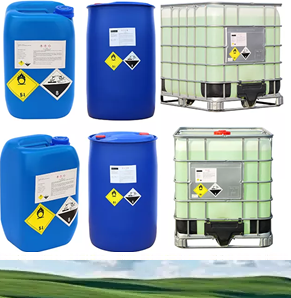
Certification also implies passing safety audits for logistics. Hydrogen peroxide is a strong oxidizer and must be handled with specialized equipment.
- Venting: $H_2O_2$ containers must have vented caps to allow the natural release of oxygen gas.
- Materials: Store only in approved containers (HDPE, stainless steel 316L, or high-purity glass). Never use copper, brass, or carbon steel, as these metals catalyze decomposition.
- Personal Protective Equipment (PPE): Always utilize chemical-resistant gloves, goggles, and face shields.
For detailed Material Safety Data Sheets (MSDS), visit Chemicals Suppliers.
7. Market Overview and Current Pricing
Note: Prices are subject to market fluctuations, volumes, and geographic location.
| Grade |
Concentration |
Typical Price Range (Per Gallon/Bulk) |
| Industrial |
35% |
$15.00 – $35.00 |
| Food Grade |
35% |
$25.00 – $55.00 |
| Reagent (ACS) |
30% |
$60.00 – $120.00 |
| Bulk Industrial |
50% |
Request Quote for Tanker Pricing |
To get the most accurate, live pricing for your specific volume needs, contact our team at Chemicals Suppliers.
8. Where to Buy Certified Hydrogen Peroxide
Not all chemical suppliers are created equal. When sourcing hazardous or sensitive chemicals like $H_2O_2$, you need a partner who provides full Certificate of Analysis (COA) documentation for every batch.
At Chemicals Suppliers, we specialize in the distribution of high-purity, certified chemicals. Whether you need lab-scale quantities or industrial-scale tankers, our supply chain is optimized for compliance, purity, and safety.
Why choose us?
- Full documentation and batch tracking.
- Compliance with international safety shipping regulations.
- Rapid distribution networks.
- Customer-centric technical support.
Visit our catalog today at ChemicalsSuppliers.com to secure your order.
9. Conclusion
Hydrogen peroxide is an invaluable tool in the modern industrial landscape. However, the difference between a successful operation and a safety incident often comes down to the quality of the raw material. Obtaining Hydrogen Peroxide Certification ensures that you are working with a product that meets the highest safety and effectiveness standards.
By prioritizing transparency, adhering to regulatory standards, and sourcing from reputable distributors like Chemicals Suppliers, you protect your personnel, your products, and your bottom line.
Frequently Asked Questions (FAQ)
1. What is the difference between technical and food-grade peroxide? Technical grade is for industrial use and may contain stabilizers unsuitable for human or food contact. Food-grade ($H_2O_2$ Food Grade) must meet strict purity standards to ensure it is free from heavy metals and toxic stabilizers.
2. How do I verify a Certificate of Analysis? When you order from Chemicals Suppliers, each shipment includes a COA. You can cross-reference the batch number with our internal records to confirm the testing results.
3. Does Hydrogen Peroxide expire? Yes. While it is stable, it slowly decomposes into water and oxygen over time. Always store in a cool, dark place and check the expiration date provided on the label.
External Resources for Further Reading
Keyword Tags
#HydrogenPeroxide #H2O2Certification #ChemicalSuppliers #IndustrialChemicals #FoodGradePeroxide #ChemicalPurity #SafetyStandards #LaboratoryChemicals #BulkChemicalSupply #ChemicalSafety #ACSGrade #PeroxideHandling #ChemicalCompliance #WaterTreatmentChemicals #HazardousMaterialsSupply #IndustrialSafety #ChemicalAnalysis #HydrogenPeroxidePrice #ChemicalsSuppliers